betPawa Zimbabwe review: what the records show about betpawa.co.zw
Access failures, not bonus terms, are what usually push a Zimbabwean bettor to start reading paperwork. The pattern repeats itself: a balance is sitting in the account, the login stops working or a verification wall appears mid-session, and support replies with a template. The questions narrow fast. Which company is holding the money? Which regulator has that company on record for the exact web address in use? And what proof does the account holder actually hold if the money never arrives?
Those three questions frame the assessment of betPawa's Zimbabwe-facing address, betpawa.co.zw. The locked-account opening is illustrative rather than a reported case; no complaint against the address appears in the accepted evidence set. What the set does contain is thin: a licensing locator context checked on 22 August 2026 that publishes no address linkage, and an automated technical profile of the domain from the same date. That supports an amber position on open evidence, which is neither a verified clean record nor an adverse one.

The exact address under assessment
The subject is one hostname: betpawa.co.zw. That precision matters more in Zimbabwe than most players expect. A brand name can travel across several African markets, through app listings, shop signage and social pages, while a gambling licence is granted to a named company inside one jurisdiction. A favourable finding for a Kenyan or Ghanaian address carries no weight for a .co.zw address, and an agent shop-front is not a website authorisation.
Three links must hold for a clean identity chain: address to company, company to licence, licence to current validity. In the accepted records the chain stops at the first link. No primary record names a Zimbabwean operating company for the address, no licence number is matched to it, and no expiry date exists to re-check later.
| Check | Finding | Tier | Record |
|---|---|---|---|
| Exact address assessed | betpawa.co.zw, treated as the sole subject | primary | ZW-S044 |
| Zimbabwean operating company | Not primary-verified | none | not in set |
| Licence number tied to the address | No current exact-address match | operator | ZW-S043 |
| Licence expiry | Not established | none | not in set |
| Locator entry linking name to address | Linkage not published | operator | ZW-S043 |
| Independent technical profile | Observable domain properties only | primary | ZW-S044 |
| Withdrawal test by our team | Not conducted | none | not in set |
| Adverse ruling by a competent body | None recorded | none | not in set |
What the licensing locator shows, and what it withholds
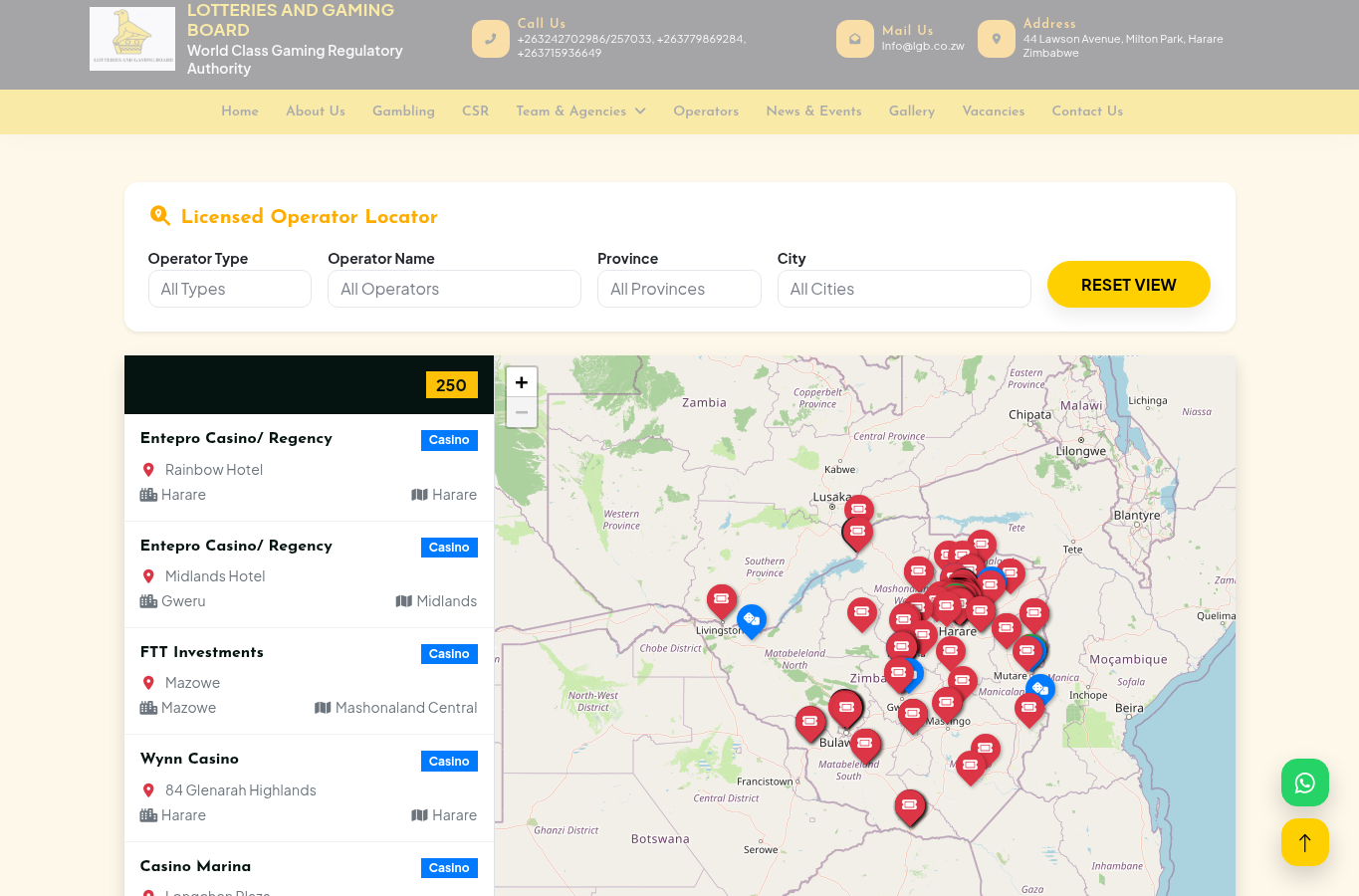
The LGB operator locator context was checked on 22 August 2026 for betPawa. The result is a gap rather than a verdict: the published context does not tie licensed names to specific websites. A name can sit in a regulatory context while the hostname a player types stays unaddressed by the record.
The same limitation appeared on the same date for every other Zimbabwe-facing brand in the queue, from AfricaBet and Premier Bet through to ShashaBet and Linbets, which places the gap in the register's publishing design rather than in one operator's conduct. It also means a screenshot of a locator screen is not a licence match. The capture is retained with its date so the state of the record on that day can be re-read.
Legal or not: the honest state of the licence question
For a bettor, legality turns on whether the company operating the address holds a current Zimbabwean licence. The accepted records neither confirm nor deny that for betpawa.co.zw. Two mistakes are common at this point. The first treats missing published linkage as proof of unlicensed operation, which a locator that never publishes website data cannot deliver. The second treats market visibility, such as advertising, agent outlets, sponsorships or app availability, as authorisation, which it is not.
Until a dated primary record ties the address to a licensed company, the defensible reading is unresolved rather than cleared, and stake sizing should reflect that. Our approach to matching an authorisation to a specific address is set out under licence checks.
Scam or legitimate: what a technical profile can prove
An automated domain profile for the address was reviewed on 22 August 2026, and it reports what such tools observe: registration and hosting characteristics, reachability and an algorithmic risk score. Those outputs describe infrastructure. They do not establish who holds a licence, which company banks the deposits, or whether withdrawals are paid. A favourable automated score is not a payout guarantee and a poor one is not proof of fraud; the profile can be read at the automated domain check.
On the accepted set a red signal is unavailable, because no official adverse record and no corroborated documented harm exists. Green is unavailable too, because no current primary evidence ties a licence to the exact address. Amber with the gaps named is what the evidence carries.
| Record type | Can establish | Cannot establish |
|---|---|---|
| Dated locator context | That a name sat in a licensing context on a date | Which website address that name operates |
| Automated domain profile | Technical properties of the address | Licence status, company identity, payout conduct |
| Commercial review of a rival product | That a product is marketed to Zimbabwe | Licence, ownership or tested outcomes for any address |
| Information site with unattributed feedback | That public sentiment exists | Verified facts about a specific dispute |
| Operator's own pages | What the business states | Independent confirmation of the statement |
| A player's receipts and ticket numbers | What happened inside one account | A pattern across the customer base |
Deposits: recorded facts and the gaps around them
No record in the accepted set establishes which deposit channels the address supports, what minimum applies, or which merchant name appears on a payment confirmation. Anything listed in the cashier or on the operator's own pages is a business statement and stays in that tier until a receipt confirms it.
That gap is workable if the first transfer is treated as a test rather than a commitment. Fund the smallest amount accepted, keep the mobile-money or bank confirmation, and compare the merchant or biller name on it against the brand shown in the cashier. A mismatch is not automatic evidence of wrongdoing, since processing is often handled by a separate entity, but it is the thread to pull before a larger transfer. One instruction deserves a hard stop: a request to send funds to a personal number, personal wallet or an agent's own account instead of a registered merchant code. Deposit-side checks are collected under payments.
Withdrawals and building a claim that survives scrutiny
No withdrawal test for the address exists in the accepted set, so no payout timing, approval rate or processing window can be stated. What can be stated is which materials turn a frustrated account holder into a documented claimant.
A provable claim usually holds a balance screenshot showing the account identifier with a visible date and time, the withdrawal request confirmation and its reference number, a statement line from the receiving mobile-money or bank account showing non-arrival, the full support thread with ticket numbers, and a saved copy of the terms in force on the request date rather than a version published afterwards. Screenshots with no account identifier, and balances never submitted through a withdrawal request, are the weakest possible starting position: they show a number on a screen and nothing about entitlement.
Identity checks and the verification wall
Nothing in the accepted set documents the operator's verification requirements, accepted document list or review timelines, so the guidance below protects the account holder's position rather than describing a published policy.
Most access holds trace back to a mismatch: a payment instrument in one name, an account registered in another, or a mobile number that has changed hands. Registering with the number and identity details that match the payment method removes the most common trigger before it can appear. When documents are requested, upload them inside the product or send them to the support address reached from the hand-typed hostname, never to a chat number found in a comment thread, advert or forwarded message. Ask in writing for the specific rule being applied and the expected review window, and keep a dated note of what was submitted.
Complaint route and the order of escalation
A complaint is an allegation until a competent body rules on it, and holding that line is what keeps an escalation credible. It also sets the order: internal first, payment provider second, regulator third once a company is actually identified.
The internal step should be a written complaint rather than a chat message, carrying the account identifier, dates, reference numbers, the amount and a request for a final written response with an internal reference. Funds that left a mobile-money or bank account but never reached the betting balance are a payment matter as much as a gambling one, and the provider's dispute channel can trace them independently. A regulatory approach becomes actionable only when a named licensed company can be tied to the address, which the current records do not do. Case routing is described under complaints.
| Step | Timeframe to set | What to send | Realistic outcome |
|---|---|---|---|
| Written internal complaint | 5 working days to acknowledge | Account ID, dates, references, amount | A ticket number and a documented start date |
| Request a final written response | 10 to 15 working days | The same pack plus the acknowledgement | A stated position you can quote later |
| Payment provider trace | Immediately for missing transfers | Transaction reference and confirmation message | Confirmation of where the funds settled |
| Licensing or regulatory contact | Once a company is identified | Full pack plus the final response | Review of a licensed company's conduct |
| Consumer or police report | Only for suspected criminal fraud | Everything, unedited | A case reference outside the gambling channel |
Copy addresses and how neighbouring records compare
Clone risk peaks at exactly the moment described at the start, when a locked-out account holder searches for an alternative link. Type the hostname by hand instead of following adverts, comments or forwarded links, watch for inserted words, hyphens and swapped characters, confirm the padlock resolves to the same host, and check the developer name before installing any app. A .co.zw suffix proves nothing about authorisation, and neither does a polished layout.
Comparison also calibrates what other public sources are worth. A commercial review of a rival Zimbabwe-facing product, such as this AfricaBet review, discusses payment options and assigns ratings: editorial judgement, not a licence record. An information site like the SpinCity resource names a Zimbabwe-facing address and reproduces unattributed feedback, which is sentiment rather than verified fact. Our files on those two sit at AfricaBet and SpinCity, and neither transfers to betpawa.co.zw.
Risks, unknowns and what would move the rating
The material risk is not a documented payout failure, since none is recorded, but the unresolved identity chain. If a dispute reached the stage where a regulator had to be approached, the accepted records would not tell an account holder which licensed company to name. That matters most for large balances, long-running accounts and funds left on deposit between sessions.
Two further unknowns shape daily use: verification terms are undocumented, and payment routing is unconfirmed, so the deposit-side checks above carry weight a primary record would normally carry. Deposit caps, session limits and time away keep exposure proportionate to thin evidence, and both are covered under responsible gambling and self-exclusion.
| Open question | Why it is unresolved | What would resolve it |
|---|---|---|
| Which company operates betpawa.co.zw | No primary record in the set names one | A dated regulator or registry record naming the address holder |
| Licence number and current validity | Locator context publishes no address linkage | A dated entry citing the hostname or the trading company |
| Deposit and withdrawal channels | Only business statements are available | A dated player receipt or captured cashier record |
| Verification rules and timelines | Not documented in the set | Published terms captured with a date |
| Payout behaviour | No withdrawal test conducted | A dated, documented withdrawal outcome |
| Dispute history | No competent-body ruling recorded | A published decision or enforcement notice |
If you weigh those open items and still choose to proceed, the routed entry point is Compare the catalogue first. Nothing in the current records supports treating it as a verified licensed destination.
Chronology, method and how corrections are made
Every record in the accepted set shares one check date, 22 August 2026: the locator context, the automated domain profile and the neighbouring-brand sources used for calibration. That single-date chronology is itself a limitation, because a licence position can change between checks, so the rating describes 22 August 2026 and nothing after it. Re-checks are scheduled rather than triggered by traffic.
The colour rules are fixed. Green requires current primary evidence tying a licence to the exact address. Red requires an official adverse record or corroborated documented harm. Everything between is amber with the gaps named, which is where the service currently sits. The ranking of record types appears under methodology and our standards for evidence and rights of reply under editorial policy. Corrections are welcome from players and from the business alike: send the document, its date and the address it applies to through contact, because a dated record settles more than an argument.
Frequently asked questions
Is betPawa legal in Zimbabwe?
The accepted records do not settle it for betpawa.co.zw. The locator context checked on 22 August 2026 publishes no link between licensed names and specific websites, and no primary record names a Zimbabwean company or licence number for the address. That is an open question rather than a finding of unlicensed operation, which is why the rating is amber and not red.
Is betpawa.co.zw a scam?
Nothing in the set supports that claim. There is no official adverse ruling, no corroborated documented payout failure and no dispute record from a competent body. The reviewed automated profile describes technical properties only. Absence of harm evidence is not proof of safety either, so the unresolved identity chain, not any recorded misconduct, is the reason for caution.
Why can a licensing locator not confirm the website?
Because the published context lists names without tying them to hostnames. The same gap appeared for every Zimbabwe-facing brand checked on 22 August 2026. A capture showing a name in a licensing context therefore proves the name was listed on that date, not that a particular web address belongs to the listed company.
My account is locked with a balance in it. What comes first?
Capture evidence before negotiating: a balance screenshot showing the account identifier with date and time, any withdrawal reference, the full support thread and the terms as published that day. Then file a written internal complaint with a deadline for a final written response, and trace any transfer that left your mobile-money or bank account separately with the provider.
How do I know I am on the correct address and not a copy?
Type betpawa.co.zw by hand instead of following adverts, comments or forwarded links, then confirm the browser shows the same hostname under the padlock. Check the developer name before installing any app, and stop entirely if a cashier asks for a deposit to a personal number or wallet rather than a registered merchant code.
What would change the amber rating?
Green needs a current primary record tying a licence to the exact address, such as a dated regulator entry citing the hostname or the company behind it. Red needs an official adverse decision or corroborated documented harm. A dated withdrawal outcome or captured verification terms would narrow the unknowns without moving the colour on their own.
Lotteries and Gaming Board of Zimbabwe · ZimLII · Consumer Protection Commission Zimbabwe