BolaBet Zimbabwe review: the money trail, licence match and payout risks
A transfer into an account at bolabet.co.zw leaves a record on the player's side within seconds: a wallet reference, a bank narration, a timestamp. That record is the only part of the chain a Zimbabwean player fully owns. Who receives the float, which company name sits on the receiving account, which licence covers that company, and who answers when a cash-out stops moving all rest on statements the accepted records do not close. The assessment is amber for that reason and no other.
Following the money before the first deposit
The accepted evidence holds no completed deposit, no verified cashier inventory and no payout receipt for this address. It holds an automated technical profile of the exact host and a regulator locator capture that stops short of publishing which internet address belongs to which licence. The practical consequence is unglamorous: a player's own transaction trail is the strongest evidence available here, so it should be built deliberately at the moment of the first transfer rather than reassembled weeks later from memory. Each checkpoint costs under a minute on a handset, and each answers a different question if funds later stall.
| Checkpoint | What it genuinely evidences | What it does not settle |
|---|---|---|
| Deposit confirmation on the handset | Amount, time and the account that received the funds | That the receiving account belongs to the claimed company |
| Cashier balance after credit | That the money reached a playing balance | The terms attached to that balance |
| Written support reference | That a request was logged and dated | That the request will be answered |
| Withdrawal request capture | Requested amount, method and timestamp | The processing window, which is untested here |
The exact address in scope: bolabet.co.zw
One internet address is in scope, and its spelling matters more than the brand attached to it. An automated technical profile checked on 22 August 2026 describes observable properties of that address and its certificate, the kind of data any visitor can read, and says nothing about ownership, banking or licensing. Read correctly it is a fingerprint of a server, not a character reference for a company. It cannot confirm that the company in the footer operates the address, and it cannot rule out a copy hosted elsewhere under a near-identical spelling. Two habits keep a player anchored: type the address by hand once, then return only through a saved bookmark, and confirm the certificate names that same host before a password is entered.

The licensed entity claim and the gap in the register
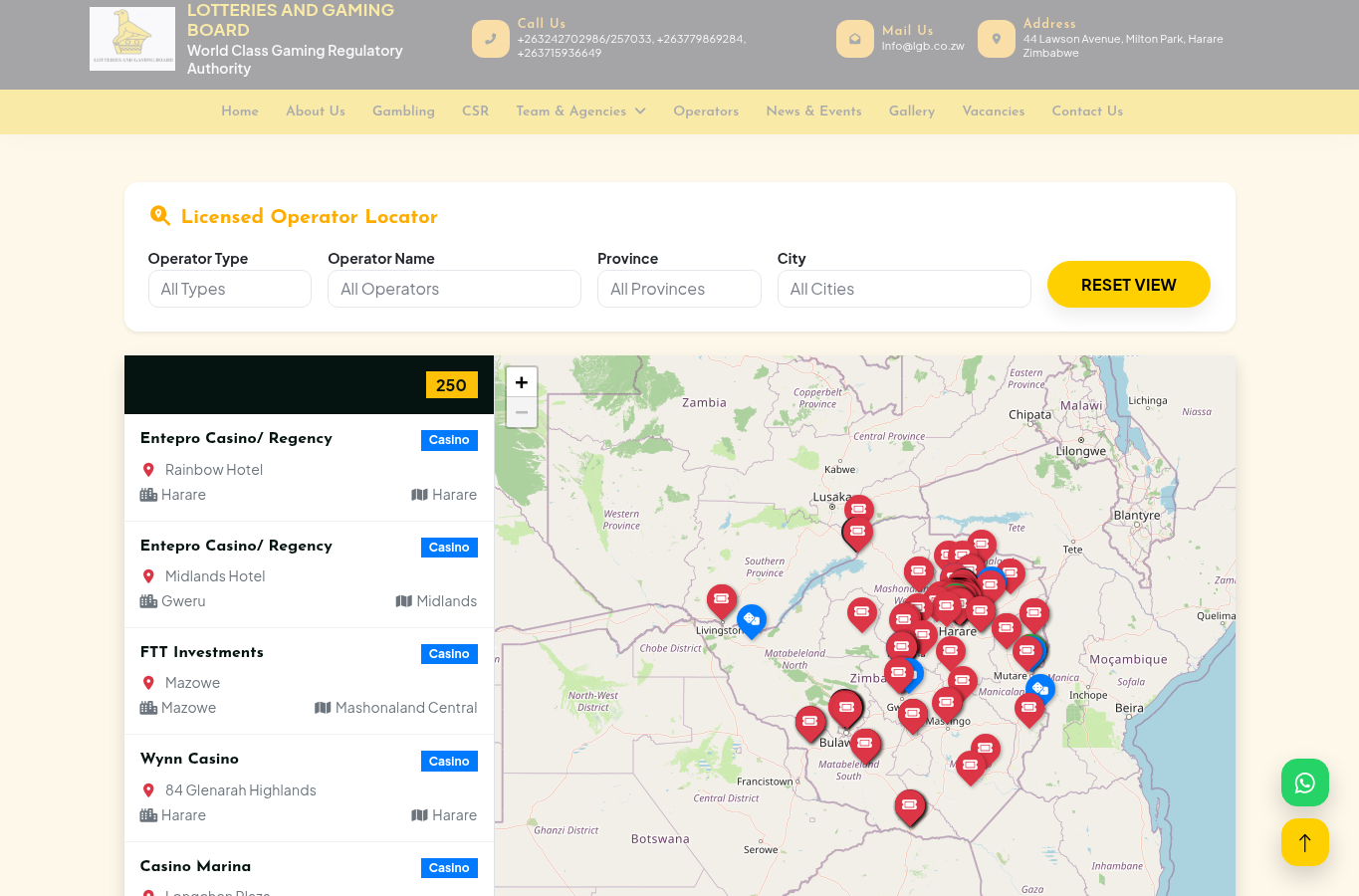
The company named as operator is BolaBet Zimbabwe (Pvt) Ltd, and licence numbers appear in operator-published material. Both are claims made by the party with an interest in them. The Lotteries and Gaming Board locator was checked for the brand on 22 August 2026, and the capture shows its limit plainly: the locator does not publish the link between a licensed company and a specific internet address. The entity may well hold a licence, and the address may well belong to it, but neither proposition is closed by a primary document in the packet. No expiry date accompanies the published numbers either, and a number without a date tells a player only that a number exists.
| Element | Claim or observation | Status on 22 August 2026 | Tier |
|---|---|---|---|
| Exact address | bolabet.co.zw | Observable and technically profiled | primary |
| Trading name | BolaBet | Displayed on the address | operator |
| Legal entity | BolaBet Zimbabwe (Pvt) Ltd | Operator claim, unmatched to a register entry in the packet | operator |
| Licence numbers | Operator-published | No exact-address match available | operator |
| Licence expiry | Not published | Unknown | none |
| Address-to-licence linkage | Not published by the locator | Open | operator |
Payment audit: settle the receiving side first
No payment method is confirmed for this address in the accepted records, so none is named here. The audit belongs on the receiving side rather than the brand of the wallet: whose name appears on the account taking the money, whether it matches the claimed company, and whether the reference issued at deposit can be retrieved afterwards. A receiving account in an individual's personal name, or in a company name unrelated to the claimed operator, is the clearest reason to stop before confirming a transfer. Keep the first amount small enough to write off, use one instrument only, and capture the cashier terms as they read at the moment of the deposit. The same deposit checks we apply market-wide sit behind the log below, and if those checks hold and you still choose to continue, the cashier can be reached through the Compare the catalogue first.
| Field to log | How to capture it | Why it matters |
|---|---|---|
| Receiving account name | Screenshot the payment prompt before confirming | Names the party actually holding the money |
| Transaction reference | Save the wallet or bank message, do not retype it | The only identifier shared with the operator later |
| Deposit timestamp | Unedited handset confirmation | Anchors the start of any processing claim |
| Cashier terms in force | Capture at deposit, not after a dispute | Terms can change between deposit and cash-out |
| Account identifier used | Capture of the profile page | Ties the payment to a named registration |
Withdrawals: no completed cash-out sits on the record
No withdrawal test exists for this operator in the accepted evidence, so no processing window, minimum, fee or failure rate can be stated, and any specific payout time quoted elsewhere for the address is unestablished. The workable substitute is a self-run test: the smallest amount the cashier permits, requested to the same instrument that funded the account, with timestamps recorded at request, at every status change and at receipt. Two habits reliably damage a later complaint. Opening a second request through a different method while the first is pending blurs which route failed, and playing on a balance under dispute changes the amount in question. A single untouched pending request, captured at each state, escalates far more easily than a balance that has moved three times.
Verification and the name-mismatch trap
Identity checks are where an unverified payment chain usually breaks. The records contain no verification policy for this operator, so requirements, timing and accepted documents are unknown. The failure mode is predictable regardless: the name on the registration, the name on the identity document and the name on the wallet or bank account must be the same person, spelled the same way. Accounts funded from a relative's wallet, a workmate's handset or a shared line are the ones that sit in review without an end date. Upload documents only through the logged-in area or the operator's own support channel, keep a copy of what was sent and when, and never post identity pages into public groups while chasing a delay. A document request arriving from outside the account stays unverified until it appears inside it.
Complaint route that keeps evidence usable
Escalation works in order, and each step needs the reference the previous one produced. Begin in the operator's support channel and insist on a written ticket reference, because a chat that closes without one is not a record. Approach the regulator only after the operator has had a written, dated opportunity to answer, and quote the exact address, the account identifier and the transaction references instead of a narrative. The accepted records establish no statutory response window, so no deadline is claimed; a dated log kept by the player does the same work. Structured escalation templates sit under complaint handling, and a documented case can be sent to us through our contact route.
| Step | Where it goes | What to include | What to keep |
|---|---|---|---|
| 1 | Operator support desk | Account identifier, transaction reference, requested outcome | Ticket reference and timestamp |
| 2 | Written escalation to the operator | Dated summary, prior ticket reference, the deadline you set | Sent copy and delivery proof |
| 3 | Lotteries and Gaming Board | Exact address, entity name as claimed, evidence bundle | Submission copy and any acknowledgement |
| 4 | Payment provider dispute path | Transfer reference, receiving account details, timeline | Provider case number |
Clone, mirror and shortcut checks
Because the locator capture publishes no address linkage, a lookalike cannot be excluded by a register lookup, which shifts the burden onto the player. The risky arrival routes repeat themselves: a shortened link in a group chat, an alternate address listed by a third party, a sponsored post attached to a bonus, or an installer file offered outside an official store listing. Each can present a convincing copy of a cashier while harvesting a login and a wallet PIN. A short discipline covers most of it. Compare the address character by character, including the .co.zw ending. Refuse any page that asks for a mobile-money PIN, since such a deposit is authorised on the handset rather than typed into a website.
Legal or not, scam or legit: what the evidence carries
Both questions have honest answers narrower than a verdict. On legality, gaming licensing in Zimbabwe is administered by the Lotteries and Gaming Board, the locator was checked on the recorded date, and it does not publish which address belongs to which licence: an absence of published linkage, not an adverse finding. On the second question, the packet contains no official adverse record, no dated sanction and no corroborated documented case of withheld funds for this address. Neither a clean bill of health nor an accusation is supportable, which is what amber records: claims that are unverified rather than contradicted. Green would need current primary evidence naming this precise address alongside a licensed company. Red would need an official adverse record, or documented evidence corroborated across independent records.
Risk register and open unknowns
The items below are open questions rather than allegations, and each is written so a reader can see what would close it.
- Address-to-licence linkage: unresolved because the locator lists entities without addresses; closed by a dated primary record naming this host.
- Licence validity period: no expiry is published; closed by a dated register entry or an official certificate.
- Receiving-account identity: unknown until a deposit prompt is read; closed by a prompt naming the claimed company.
- Payout behaviour: untested; closed by a documented cash-out with timestamps at each state.
- Verification terms: absent from the packet; closed by the policy shown inside a logged-in account.
- Copy addresses: cannot be excluded by lookup; reduced by a bookmark and a certificate check.
The lookup order behind register work is set out under licence verification, and a deposit limit or a break can be arranged through responsible gambling tools or a self-exclusion request before any of this is tested with money.
Evidence chronology, tiers and the correction path
Every claim carries a ledger identifier and a check date, and three tiers stay separate: primary records, operator statements and user-generated context. Under that discipline, the corporate name and licence numbers for this brand are operator statements; the technical profile of the address is a primary record of observable properties only; and unattributed feedback, wherever it appears, is context that cannot settle a payment dispute.
| Date | Ledger ID | Tier | What it establishes | What it does not establish |
|---|---|---|---|---|
| 2026-08-22 | ZW-S013 | operator | Locator context checked for the brand | Any link between a licence and the address |
| 2026-08-22 | ZW-S014 | primary | Observable address and certificate properties | Ownership, banking or licensing |
| 2026-08-22 | ZW-S002 | primary | A Zimbabwe-facing AfricaBet product and its payment discussion | Proof standards for the address examined here |
| 2026-08-22 | ZW-S005 | primary | A SpinCity domain identification with unattributed feedback | Verified payout outcomes for any player |
For contrast on how a Zimbabwe-facing address gets documented elsewhere in the market, a commercial review of AfricaBet discusses that product's payments without reaching primary proof, and an independent information site for SpinCity identifies its domain while publishing unattributed feedback. Neither carries across, and both are recorded only to show why address-level documentation, not brand familiarity, decides a signal. Our own files on those two sit at AfricaBet and SpinCity.
Corrections are welcome and they need to be specific. A dated document naming this exact address alongside a licensed company, an official notice, or a payment record that contradicts anything stated will move the assessment; an undated screenshot without a source will not. The standards applied are published under editorial policy and the scoring order under assessment method. The signal is revisited whenever a dated record changes, not on a fixed calendar.
Questions players ask about the operator
Is BolaBet legal in Zimbabwe?
Licensing is administered by the Lotteries and Gaming Board, and the locator captured on 22 August 2026 does not publish which internet address sits under which licence. The corporate name and licence numbers in circulation are operator statements. Legality is therefore unconfirmed for this address rather than disproved, which is why the signal is amber.
Is the operator a scam?
Nothing in the accepted records supports that description. There is no official adverse record, no dated sanction and no corroborated documented case of withheld funds tied to the host. Equally, no primary document ties the address to a licensed company, so the honest position is unverified, neither cleared nor condemned.
Which licence number covers the exact address?
None can be matched from the packet. Numbers appear in operator-published material, but the locator capture lists entities without addresses, and no expiry date is published alongside them. A number becomes useful only when a dated record names both the company and the address it serves.
Which payment methods can I use?
The accepted records confirm none, so no method is listed. Read the cashier at the moment of deposit and record the name on the receiving account, the reference number and the timestamp. If the receiving account is in a personal name or an unrelated company, stop before confirming the transfer.
What should I do if a withdrawal stops moving?
Leave the request untouched, keep the balance unplayed, and capture each status change with its time. Ask support for a written ticket reference, then escalate in writing to the operator before approaching the regulator, quoting the address, the account identifier and the transaction references.
How do I know I am on the genuine address and not a copy?
Type the address by hand, including the .co.zw ending, and return to it from a saved bookmark rather than a shared link. Check that the certificate names that same host. Refuse any page asking you to type a mobile-money PIN, because those deposits are authorised on the handset.
What would change the amber assessment?
A dated primary record naming the exact address alongside a licensed company would support green. An official adverse record, or documented evidence corroborated across independent records, would support red. Anything sent with a date and a traceable source is reviewed, and the signal is reissued when the record changes.
Is BolaBet legal in Zimbabwe?
Is the operator a scam?
Which licence number covers the exact address?
Which payment methods can I use?
What should I do if a withdrawal stops moving?
How do I know I am on the genuine address and not a copy?
What would change the amber assessment?
Lotteries and Gaming Board of Zimbabwe · ZimLII · Consumer Protection Commission Zimbabwe