Can Zimbabwe residents use Stake legally and under its terms?
Short answer: a person located in Zimbabwe or resident in Zimbabwe is expressly prohibited from using Stake under the operator’s own terms. Clause 14.3 names Zimbabwe as a prohibited jurisdiction, while clause 14.4 forbids attempts to bypass the restriction through a VPN or proxy. The Zimbabwe regulator’s operator locator also did not bind the exact stake.com domain to local permission in the check dated 1 October 2026. That locator result is not, by itself, a formal ruling that Stake is illegal or a scam.
The decision for a Zimbabwe-based user
The practical outcome is not ambiguous. Even if stake.com loads on a device in Zimbabwe, the operator’s contractual restriction says that a person located in or resident in Zimbabwe may not use the service. Accessibility is a technical observation; it is not permission, eligibility or regulatory approval.
The restriction also rules out a workaround. Stake’s terms expressly prohibit VPN or proxy circumvention. Changing an apparent location would therefore not resolve the eligibility problem and could create further account risk under the same terms. No workaround should be treated as a lawful or contract-compliant route to play.
| Question | Evidence-led answer | Reason |
|---|---|---|
| Is Stake allowed for a person in Zimbabwe? | No under Stake’s published terms | Zimbabwe is named as a prohibited jurisdiction |
| Does a loading website prove eligibility? | No | Reachability does not override contractual or local requirements |
| Can a VPN or proxy solve the restriction? | No | Clause 14.4 expressly forbids circumvention |
| Was local permission for stake.com established? | No | The regulator locator did not bind that exact domain to permission |
The evidence signal remains amber rather than green because current primary evidence does not establish Zimbabwe permission for the precise domain and entity. It is not red because the supplied primary record is not an official adverse decision against Stake. The clearest negative point comes from the operator’s own restriction.
What Stake’s prohibited-jurisdiction terms say
The operator terms checked on 1 October 2026 contain two provisions that matter directly. Clause 14.3 names Zimbabwe among prohibited jurisdictions and states that people located in or resident in those jurisdictions may not use the service. Clause 14.4 prohibits efforts to evade geographic restrictions by using a VPN, proxy or similar method.
These are self-published operator terms, not a statement issued by the Zimbabwe regulator. That distinction matters: the terms establish Stake’s contractual position towards Zimbabwe users, but they do not independently decide every question of Zimbabwean law. Nevertheless, a user considering whether Stake Zimbabwe access is allowed does not need to speculate about the operator’s stance. The operator itself says no.
| Record | What it supports | What it does not support |
|---|---|---|
| Stake terms, clause 14.3 | Zimbabwe residents and people located in Zimbabwe are prohibited from using the service | A regulator finding that Stake committed an offence |
| Stake terms, clause 14.4 | VPN and proxy circumvention is forbidden | Any acceptable workaround |
| Zimbabwe operator locator | No exact domain-to-permission link was established in this check | A conclusive declaration that the domain is illegal |
| Stake card-withdrawal help | General conditions for a limited card-return facility | Zimbabwe availability or a successful local withdrawal |
No licence number, local legal entity, Zimbabwe payment eligibility or account exception has been established from the supplied records. Those details must remain unknown rather than being inferred from the brand name, website design or service availability in another country.
Commercial link to a different option; not evidence that the reviewed brand is safe or pays withdrawals.
What the Zimbabwe regulator record establishes
The relevant primary source is the operator locator published by the Lotteries and Gaming Board of Zimbabwe. In the check dated 1 October 2026, the locator did not bind stake.com to local permission. Readers can consult the Zimbabwe operator locator and should compare the exact host, named entity and authorisation details rather than relying on a similar trading name.
This result must be interpreted carefully. An absent exact-domain match is not automatically an official finding of illegality. Operator locators may organise information by names or records that do not expose every domain relationship. The available evidence therefore supports an “unverified locally” conclusion, not a claim that the regulator has issued an adverse order.
It would also be unsafe to substitute a foreign licence for Zimbabwe permission. Licensing is territorial and entity-specific. A reference to regulation elsewhere does not establish that stake.com may accept a person located in Zimbabwe. Guidance on checking the correct fields is available in the Zimbabwe online casino licence guide.
Exact-domain and entity checks matter
“Stake” is a brand reference, while stake.com is a specific host. A meaningful verification needs to connect that host to a named legal entity and then connect the same entity and activity to current Zimbabwe authorisation. A partial name match does not complete that chain.
Use a disciplined sequence before treating any online gambling site as locally authorised:
- Write down the exact hostname shown in the browser, including any subdomain.
- Find the legal entity identified in the site’s contractual documents.
- Check whether the Zimbabwe regulator record identifies that entity and relevant activity.
- Look for an explicit connection between the regulated entity and the exact domain.
- Confirm that the record is current and that no territorial exclusion contradicts eligibility.
| Verification item | Status in the supplied Stake evidence | Consequence |
|---|---|---|
| Exact host assessed | stake.com | Avoids relying on brand resemblance alone |
| Zimbabwe permission tied to host | Not established | Do not describe the service as locally licensed |
| Operator position on Zimbabwe | Explicitly prohibited | A Zimbabwe user should not register, deposit or play |
| VPN or proxy exception | None established; circumvention is forbidden | Do not attempt to bypass the restriction |
| Local payout test | None conducted | No claim about withdrawal success is justified |
The broader licence-check process explains why a logo, payment option, sponsored mention or foreign registration cannot replace a direct regulator-to-domain connection.
Credit-card withdrawal rules do not create eligibility
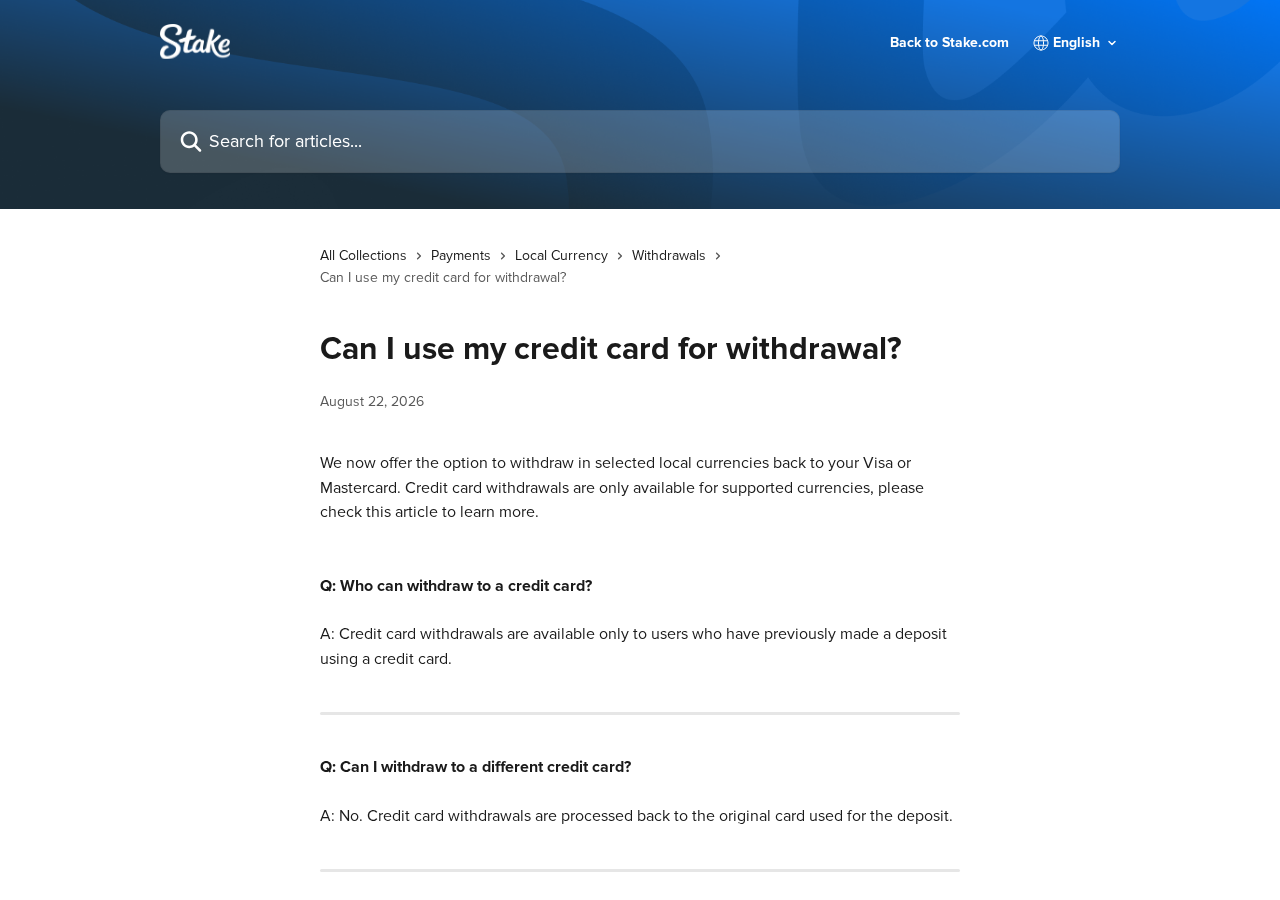
A Stake help article dated 22 August 2026 describes a credit-card withdrawal facility, but only for selected supported currencies. It says a user must previously have deposited by credit card and that funds are returned to the original card. These conditions describe how a limited method may operate for eligible customers; they do not say the method is available to users in Zimbabwe.
The distinction is important because payment visibility is sometimes mistaken for jurisdictional permission. A card button, currency reference or generic help article cannot override the prohibited-jurisdiction clause. Nor does a payment method establish that the operator holds local authorisation.
No Zimbabwe card deposit was made for this assessment, no withdrawal was requested, and no outcome was observed. There is consequently no factual basis for claims about processing time, fees, acceptance rates or whether a Zimbabwe-issued card would work. General payment-risk considerations can be reviewed through the payments guide, but they do not alter Stake’s restriction.
“Legit” and “scam” are not interchangeable with eligibility
The question “Is Stake a scam or legit in Zimbabwe?” combines several different issues. One issue is whether the website corresponds to the intended brand. Another is whether an operator is locally authorised. A third is whether its own contract permits the user’s location. These questions require different evidence and should not be collapsed into one label.
The supplied records do not establish that Stake is a scam. They also do not establish Zimbabwe permission for stake.com. What they do establish is that Stake’s own terms prohibit people resident in or located in Zimbabwe. That contractual fact is sufficient to make the service unsuitable for a Zimbabwe-based user, without making an unsupported accusation.
User allegations, ratings and forum reports were not supplied as evidence and are not part of the verdict. No complaint, payout failure, account closure or personal experience has been attributed to Stake here. If a reader already has a dispute, the appropriate path is to preserve records and use the complaints guidance, rather than relying on broad online labels.
Risks of ignoring the restriction
Attempting to register or transact despite a clear territorial exclusion creates avoidable uncertainty. The operator’s own rules say the location is prohibited, and the available evidence contains no exception for Zimbabwe citizens, residents, travellers or particular payment methods.
A VPN or proxy is especially unsuitable because clause 14.4 directly forbids circumvention. It may also make account information inconsistent with connection data or payment records. No prediction is made here about how Stake would handle a particular account, because no documented Zimbabwe case or withdrawal outcome was supplied. The key point is simpler: circumvention conflicts with the published terms.
- Do not treat website access as permission to register.
- Do not enter an inaccurate residence or location.
- Do not use a VPN, proxy or similar tool to defeat the restriction.
- Do not deposit on the assumption that a visible payment method ensures withdrawal.
- Do not rely on a foreign licence as proof of Zimbabwe authorisation.
Anyone who feels pressured to continue gambling, recover losses or find another route around a block can use responsible gambling support or the self-exclusion guide. These support routes do not require continued play.
What to do if money or an account is already involved
If an account already exists, avoid adding further funds merely to test whether withdrawals work. Preserve the account terms that applied, transaction references, dates, balances, identity-check requests and all support correspondence. Keep original files where possible and note the exact domain used.
Contact the operator through the support route shown within the genuine account environment and ask for a written explanation of account status and available withdrawal procedures. Do not misstate location and do not use circumvention tools. The available evidence does not establish what resolution Stake will offer in any individual case.
If the response is unclear, organise the evidence chronologically before escalating. Separate confirmed transactions from assumptions, and distinguish an operator statement from a regulator decision. The complaints route provides a structured record checklist. Immediate gambling-related harm, coercion or severe distress calls for the resources listed under urgent help.
| Keep | Why it matters |
|---|---|
| Exact domain and account identifier | Connects the dispute to the correct service |
| Deposits, attempted withdrawals and timestamps | Creates a transaction chronology |
| Terms and messages received | Records what the operator represented |
| Identity or location requests | Shows what verification was sought |
| Support reference numbers | Allows later correspondence to be traced |
Commercial link to a different option; not evidence that the reviewed brand is safe or pays withdrawals.
Evidence verdict and unresolved points
The evidence verdict is amber. The operator evidence is clear that Zimbabwe is prohibited, but the supplied primary regulator record does not amount to an official adverse decision. It also does not establish local permission for the exact stake.com host. For a Zimbabwe resident or anyone physically located in Zimbabwe, the practical answer remains: do not use Stake and do not attempt a workaround.
Several matters remain deliberately unresolved. There is no verified Zimbabwe licence number for the exact domain, no established local entity-to-domain connection, no local deposit test, no withdrawal test and no documented complaint outcome. The general card help record cannot fill those gaps.
The safest comparison is with operators whose exact domains and entities can be tied to current local evidence. The casino directory should be read alongside the underlying licence checks, not as a substitute for them. Local permission, contractual eligibility and payment functionality are separate tests; all should align before money is committed.
Stake Zimbabwe questions answered
Can a person in Zimbabwe use Stake?
No under Stake’s published terms checked on 1 October 2026. Clause 14.3 names Zimbabwe as a prohibited jurisdiction and says people located in or resident there may not use the service.
Is Stake legal in Zimbabwe?
The supplied regulator locator did not bind stake.com to Zimbabwe permission, but that absence alone is not a formal illegality ruling. Independently, Stake’s own terms prohibit Zimbabwe residents and people located in Zimbabwe from using the service.
Can I use a VPN to access Stake from Zimbabwe?
No. Clause 14.4 of Stake’s terms forbids VPN or proxy circumvention. A workaround would not cure the eligibility problem and should not be attempted.
Does Stake support credit-card withdrawals in Zimbabwe?
Zimbabwe availability was not established. Stake’s general help article says card withdrawals are limited to selected supported currencies, require a previous card deposit and return funds to the original card. It does not make the method available to Zimbabwe users.
Is stake.com confirmed as locally licensed?
No. The Zimbabwe operator locator did not provide an exact domain-to-permission connection for stake.com in this check. A foreign licence or accessible website should not be treated as a Zimbabwe licence.
Does the restriction prove Stake is a scam?
No. The restriction establishes that Stake does not permit use by people located in or resident in Zimbabwe. The available evidence does not support calling the brand a scam.