Bezbets review for Zimbabwe: is bezbets.co.zw the real host?
Zimbabwean searches for Bezbets return a brand that looks settled and a web address our records cannot vouch for. The file behind the entry holds one captured regulator-locator reading, one independent published account of payout disputes, and no primary record tying a licence to the exact address. The first test here is therefore an address test, not a tour of features.
Begin with the lookalike-address test, not the brand name
The name on the screen is the weakest link in the identity chain. A near-identical address can be registered in minutes, the colours copied and the mark reused, and most Zimbabwean players arrive on a forwarded WhatsApp link or a paid search result rather than by typing anything. So put the address you actually loaded beside the one our file scopes, bezbets.co.zw, and compare it character by character: exact brand string, exact suffix, no hyphen, no doubled letter, no extra word in front, no third-level prefix that merely looks official.
We list no confirmed copycat addresses, because none was captured for us and inventing one would be worse than useless. The matching name is the trap: it sits in our locator reading with no address published beside it, which is exactly the gap a lookalike lives in.

What the registered address establishes about the host
Scope is one address and one market, read from Zimbabwe on 22 August 2026. A country-code name is a weak signal in both directions: it shows someone wanted a local footprint, meaning local advertising, local payment rails and local customers, but a registration is not a permission, and nothing about the suffix implies approval.
Three things the file does not contain, and which we therefore do not assert: registrar or ownership data, hosting and certificate details, and any published statement from the service naming a licence number for itself. That absence is not proof of wrongdoing; it is the ceiling on what an honest reading can reach. Corporate identity, meaning company name, registration number, licence number and expiry, is simply blank here, and resemblance is not allowed to fill it.
Operator and licence: reading the LGB locator honestly
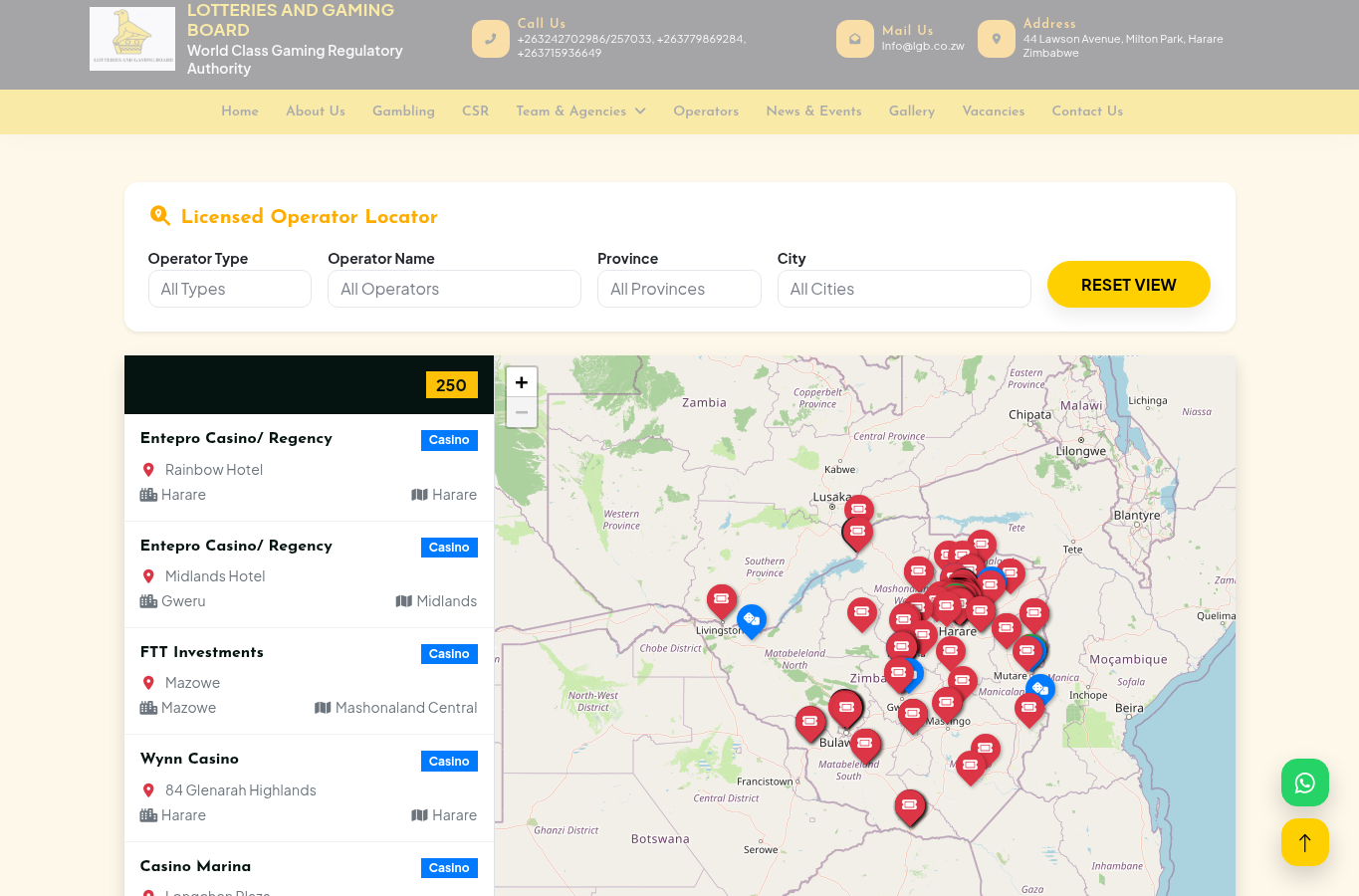
On 22 August 2026 we read the operator locator published at lgb.co.zw/operator and stored the result for Bezbets as ledger item ZW-S022. Two details outrank the match itself. The locator does not publish the web address attached to a listed operator, so a name found there cannot be converted into cover for any particular .co.zw address. And our ledger holds that reading at operator tier, not as a certified licence extract, so it cannot carry a legal conclusion on its own.
The same sweep on the same day returned the same shape for other Zimbabwe-facing names, which is the value of the comparison below: name matches are ordinary, published address linkage is absent across the board, so the match cannot be the thing that settles your mind.
| Name read in the 22 August 2026 locator sweep | Address linkage published | Ledger item | Our entry |
|---|---|---|---|
| Bezbets | No | ZW-S022 | current entry |
| AfricaBet | No | ZW-S001 | AfricaBet |
| Premier Bet | No | ZW-S010 | Premier Bet |
| betPawa | No | ZW-S043 | betPawa |
| SupaBets | No | ZW-S037 | SupaBets |
| MWOS | No | ZW-S007 | MWOS |
Why the signal is red, and what would change it
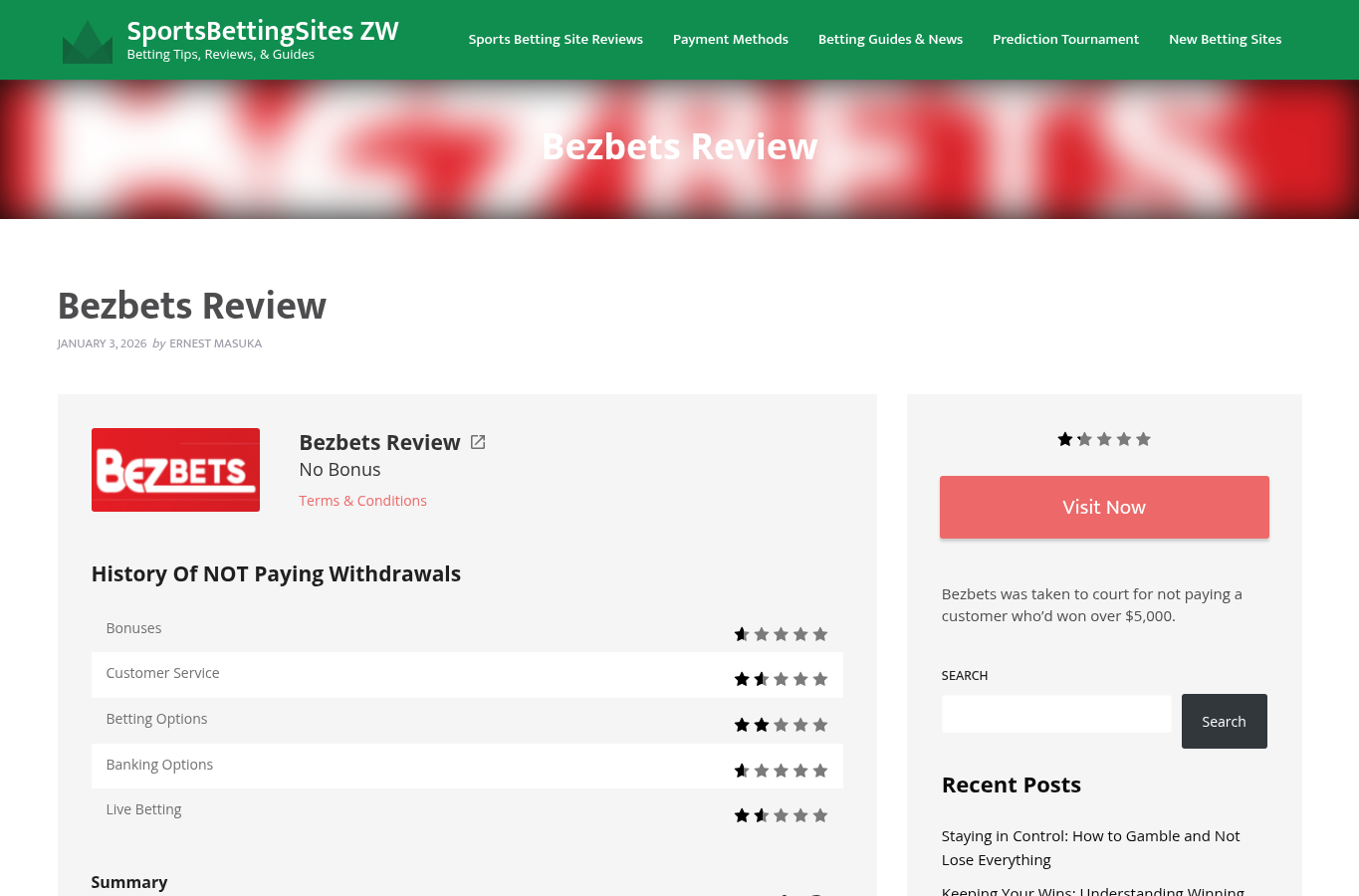
The red classification rests on two records read together. An independent Zimbabwean review publication, held as ZW-S023 at primary tier, describes payout litigation and a history of non-payment tied to Bezbets: the independent review account. Beside it sits the licence gap already described, with no published record connecting the exact address to an operator permission.
Precision matters. A documented adverse account is documented; the individual disputes inside it stay allegations until a dated ruling from a competent body is on file, and no case record was supplied. What we record is a corroborated adverse pattern in published reporting, not a proven finding against a named company.
Three changes would reopen the classification: a primary regulator record naming the exact address, a dated outcome in any dispute described, or a verifiable operator statement identifying the legal entity and licence number behind the address.
Scam, legit or legal: three questions that need separate answers
“Is it a scam” is the question asked most and answered least directly. The file supports a narrower statement: licence coverage cannot be shown for the address, and published reporting describes unpaid winnings and legal action. That is reason enough to keep money out. It is not a proven finding of fraud, and the language will not be upgraded past the evidence.
“Is it legal” splits differently. Gambling operators in Zimbabwe are licensed through the LGB, and the consequence for a player is evidentiary: in a dispute you will be asked to show which licensed host you were on, and with no published address linkage you cannot show it. Our licence-check walkthrough sets out the steps we run, and anyone weighing where to play instead can Compare the catalogue first.
Login and payment exposure before any money moves
Nothing on file establishes which deposit or withdrawal channels the address accepts, so any handle shown at the cashier, whether a mobile-money number, a bank reference or a wallet ID, is unverified here, and money sent to an unverified handle is the hardest kind to recover in this market. Two habits cut the damage in advance: use a password that exists nowhere else, so one leak cannot open your email or your wallet, and never type a mobile-money PIN into a web form, because a genuine transfer is authorised in your own wallet application or by the network's own prompt.
Capture the moment of payment, including the reference number, the receiving handle on screen, the timestamp and the balance afterwards. Our payments guidance explains why that habit outperforms every later argument.
| What a reader needs | Status in our file | Practical consequence |
|---|---|---|
| Deposit channels accepted | Not established | Treat any cashier handle as unverified until you confirm it independently |
| Withdrawal channels and limits | Not established | No basis to expect a payout route, speed or cap |
| Settlement currency handling | Not established | Confirm before funding whether a balance would sit in USD or ZWG |
| Verification requirements | Not supplied | Assume documents are requested at withdrawal, not at signup |
| Bonus and wagering terms | Not supplied | No offer shown at the cashier can be checked against a written rule |
Withdrawals, KYC and documents you cannot take back
No withdrawal test exists in our file. We have not deposited, not requested a payout and not timed one, and no such experience will be described here. What can be described is the asymmetry a reader is asked to accept: identity checks normally land at the withdrawal stage, so the money goes in first and the documents follow at the precise moment a reluctant operator has an incentive to slow down. Published reporting on Bezbets describes non-payment at exactly that stage.
No retention policy, verification turnaround or dispute timetable was supplied for the address, so each is unknown rather than reassuring. A national ID scan, a proof of address and a selfie are permanent once sent, with no recall, so the sensible order is to establish the host first and hand over documents second.
If a deposit already happened: complaint and recovery route
Paperwork and speed decide these cases. Open with a written demand through whatever contact channel the service publishes, stating amount, dates, reference numbers and a deadline, and keep it in writing even when live chat feels friendlier. Then escalate outward rather than upward inside the same company.
Two escalations run in parallel. Your payment provider has a dispute process with a time limit shorter than most players expect. The regulator side runs through the LGB's own published contact route, where the honest expectation is firm action when a licensed host can be identified and much weaker leverage when address linkage is unpublished. Because published reporting describes disputes reaching litigation, assume from day one that your records may have to satisfy a lawyer rather than a support agent. Our complaints route carries the templates, and urgent help is the right door in a crisis.
| Step | Where it goes | What to send | Realistic outcome |
|---|---|---|---|
| 1. Written demand | The service's own published contact channel | Account ID, amounts, dates, references, deadline | Creates the dated record everything later depends on |
| 2. Payment dispute | Your bank or mobile-money provider | Transfer receipts and cashier screenshots | Time-limited, and strongest while the transaction is recent |
| 3. Regulator contact | LGB, via the contact route published with its locator | The full file plus your address evidence | Leverage depends on whether a licensed host can be identified |
| 4. Legal advice | A practitioner in Zimbabwe | The same file, ordered chronologically | Proportionate for larger sums; reporting on Bezbets describes litigation |
Clone checks you can repeat in five minutes
Every check below can be run without us, which matters more than any classification we publish, and they are ordered cheapest first.
One useful contrast sits in the same sweep. For a different register name in our comparison set, an independent information site does publish the Zimbabwe-facing address, at an address-level identification, and a locally stored mark sourced from that brand's own mark file identifies that entry, proving identity only and never licensing. Those two records belong to another brand and say nothing about the address here; they show what an address-level identification looks like when it exists, and how visible its absence is in the file we hold.
| Check | How to run it | What a pass looks like |
|---|---|---|
| Address typed by hand | Enter the address yourself instead of tapping a forwarded link | The loaded address matches character for character, with no redirect to a variant |
| Locator name and address | Read the LGB locator, then look for a web address beside the entry | An address is published and matches the one you loaded, which is not achievable today |
| Licence identity on the service | Look for a licence number, legal entity and expiry in the footer or terms | All three present, consistent and checkable against a regulator record |
| Contact depth | Test whether a physical address and a working local number exist | Channels that answer, and still answer on a second attempt |
| Payment handle | Compare the cashier handle with any published company details | Names match; a mismatch of names is a stop, not a query |
Evidence chronology, unknowns, method and correction path
Every record behind the entry carries one date: 22 August 2026. That single-day shape is a genuine limit, with no earlier locator reading, no archived copy of the address and no second reading of the independent account, so a snapshot is all that can be claimed, not a trend, an improvement or a decline.
On file: one locator reading at operator tier with the name present and no address published; one independent publication at primary tier describing payout litigation and non-payment; two records belonging to another brand, used above only as contrast; and two stored captures so the reading can be audited without trusting our summary. Not on file: licence number, expiry, legal entity, ownership, payment channels, verification policy, complaint volumes and any dated case outcome.
Our methodology sets out the tier rules that stop a locator reading being promoted into a licence record, and our editorial policy covers how an adverse classification is reviewed before it stands. Corrections are welcome from any side, including the operator: send a dated document, such as a licence extract naming the address, a ruling or a payout confirmation, through our contact page and the Bezbets file will be re-read. If chasing a disputed payout has started to feel compulsive, responsible gambling support and self-exclusion options are practical steps, and our operator index is the place to start on a different address.
Questions readers ask
Is bezbets.co.zw a licensed betting address in Zimbabwe?
Not on our records. The brand name appears in the LGB locator reading we captured on 22 August 2026, but that locator does not publish web addresses, so nothing on file links a licence to this exact address. Bezbets is a name match only, and a name match is not licence coverage.
Why is the classification red rather than amber?
Because two records point the same way: an independent Zimbabwean review publication describing payout litigation and non-payment, and the absence of any published record connecting the address to an operator permission. Either alone would leave the entry amber; together, our ledger records a corroborated adverse pattern.
Does the red classification mean Bezbets has been proven to defraud players?
No. The adverse account is published reporting, and the disputes described inside it remain allegations until a dated ruling from a competent body is on file. No case record was supplied to us, so the classification describes documented risk rather than a proven finding.
How do I tell the registered address from a lookalike?
Type it yourself rather than following a forwarded link, then compare it character by character: exact spelling, exact suffix, no hyphen, no doubled letter, no extra word or prefix. Our file lists no confirmed copycat addresses, so any variant you find is unverified in both directions.
I have already deposited. What should I do first?
Send a written demand through the service's own published channel with amounts, dates and reference numbers, then open a dispute with your bank or mobile-money provider while the transaction is recent. Contact the LGB through its published route, and keep every screenshot you have.
Should I send identity documents to complete verification?
Hold them back until you can show that the address you are using is covered by a licence. An ID scan, proof of address and selfie cannot be recalled once sent, and no retention or verification policy for this address was supplied to us.
Lotteries and Gaming Board of Zimbabwe · ZimLII · Consumer Protection Commission Zimbabwe